|
The
First Principal
(1958-1965)
|

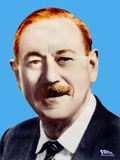
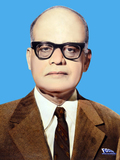
Col.(R) J.H.H. Coombes.
|
Col. Coombes
An
Introduction
By Kazi Zulkader Siddiqui, kit no. 671/Latif
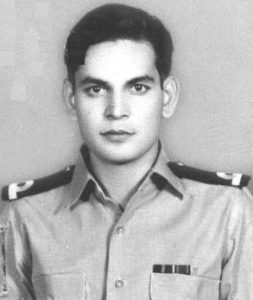
The first principal of Cadet College Petaro was
Colonel (R) John Harold Henry Coombes, CBE, E.R.D.,
M.A.(Oxon), who evokes extreme nostalgic memories
for those who have known him, have worked with
him, or were students of Cadet College Petaro
during his period. He left his mark on the college
for posterity. His vision, his tireless efforts
and his dedication towards this college continue
to bear fruits to this day. |
|
Articles in the following pages not only bring out
the story of how Petaro rose under this great man’s
efforts in such a short period of time, but these
articles also demonstrate the love these authors bore
for this great man, and also enlighten us on his life
and achievements.
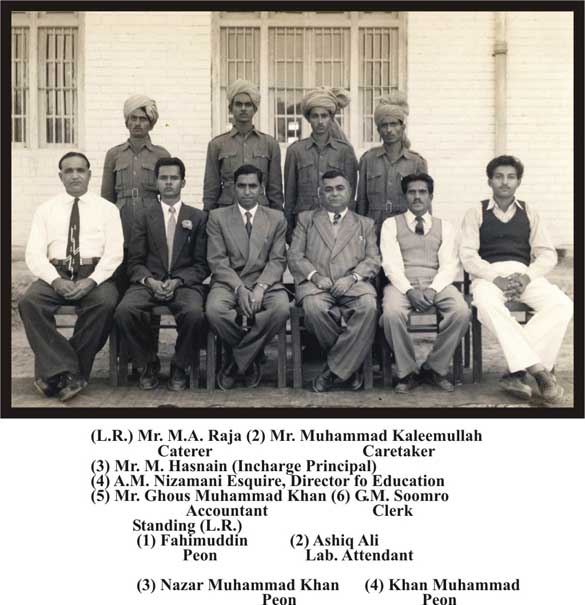
Prior to Col. Coombes, the college was run by
Mr.
Muhammad Hasnain for a short period of less than seven
months while the search for an experienced full time
principal was on. Mr. Hasnain was the In Charge (Acting
Principal) of the college from August 25, 1957 until
Col. Coombes took over as Principal on March 20, 1958.
However, Col. Coombes was in reality the first Principal
of Cadet College Petaro on a permanent basis and who
molded and built the college as such. He was given this
position in March of 1958 and he finally left the
college in 1965 when he handed over charge to
Cdr.(R)
Firoz Shah - the second principal.
Col.
Coombes was born on 28 December 1906, and died in 1978 at
Sellindge, Kent, UK. His last few years were spent at his home
in Sellindge which he had named as “Petaro” out of his extreme
love for the institution that he had built and nurtured.
The colonel married twice.
His first wife was Alice, who expired while the colonel was
still the principal of Cadet College Petaro. Later on, he
married Elsie who visited Petaro along with her husband in
1971.
Several articles have been written by his staff members and
cadets, who had virtually fallen in love with him for his
dedication. In the following pages, we have selected a few of
these prominent articles which bring out the character of this
great man.
Col.
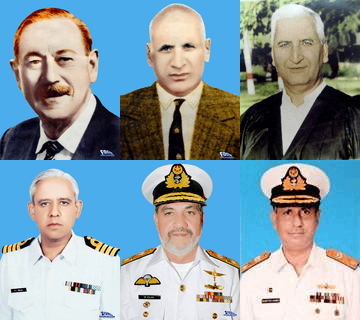
Coombes stands tall amongst all Petarians - staff and cadets.
He was a visionary and a man of action and decision. He set
the standards, and nurtured the college in its infancy and
childhood. He was followed by Cdr.(R) Firoz Shah, who brought
the college to a maturity during his tenure from 1965 to 1972
and took the college to new heights with successes in
academics and sports. His successor Prof. Syed Shaida Azim was
the only civilian principal in the history of the college.
Having been associated with the college as the Vice Principal
almost from its inception and participating alongside the
first two principals in its development, he ended up being the
third principal of the college between 1972 and 1975. Thus,
his contributions were critical for the development and growth
of this great institution. The college had matured.
Col.(R) Coombes had written his World War II memoirs,
including an account as prisoner of war during the Malaya
campaign. This book was first published in 1948 under the
title of “Banpong Express”. It was never printed again. Copies
of the first original edition are difficult to find. This book
was then reprinted as a part of a memorial book on Col.
Coombes by the Petarian Foundation on the occasion of the
Golden Jubilee of Cadet College Petaro in February 2007.
Col. Coombes - A Legend
By Mirza Ashfaque Beg, kit no. 69/Liaquat
(now retired Commodore)
[This
article was written in the beginning of 1966, when Col.
Coombes was alive and was 59 years old, shortly after he had
retired from the position of Principal of Cadet College
Petaro. It was
originally
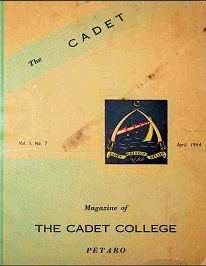
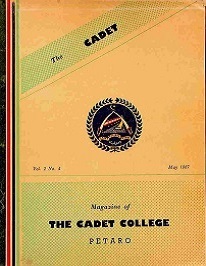
printed in The Cadet magazine of 1966 and later
again in The Cadet magazine of 1978,
and as a part of the book on Col. Coombes in
2007]
My
earliest memory of this giant of a man having a high forehead,
a big Western sheriff moustache, and pink and tan face, goes
back to my school days at Mirpurkhas about eight years ago.
My
eternal impressions of this great man
Col.
Coombes, to all appearance, is a plain, downright
matter-of-fact fellow, with much less of poetry about him than
rich prose. There is little of romance in his nature, but a
great deal of strong natural feeling. He excels in humour more
than in wit; is jolly rather than gay; melancholy rather than
morose and can easily be moved to a sudden tear or a loud
laugh; but he loathes sentimentality. He is a boon companion
if you allow him to have his humour, and he will stand by a
friend with life and purse. He is most graceful in war,
particularly when he is victorious. When praised, he will
blush like a school girl. He has an Eastern heart and Western
mind.
Though
inherently a good-hearted, good-tempered old fellow, he is
singularly fond of being in the midst of contention. It is one
of his peculiarities that he only relishes the beginning of an
affray, going into a fight with alacrity but coming out of it
grumbling even when he is victorious. Though no one fights
with more obstinacy to carry a contested point, yet when the
battle is over and he comes to reconciliation, he is so much
taken up with the mere shaking of hands, that he is apt to let
his antagonist pocket all that they have been quarrelling
about. He is like a stout ship which will weather the roughest
storm uninjured, but roll its mast overboard in the succeeding
calm.
This, in
short, is the alpha and omega of Coombes' nature as I have
learnt through years of association.
Col.
Coombes at 59 looks energetically fit. His mobile decisive
grin is still as practical and as wide as the English Channel,
and his friendly eyes are as bright a sea-blue as ever.
Early
Life:
Young
John's early life can be condensed into a single sentence
which is aptly quoted in Gray's Elegy:
"That
short and simple annals of the poor".
He was
born on 28th December 1906 and named John Harold
Henry Coombes. His father was a fisherman in Guernsey, the
second largest of the Channel Islands. His mother died when he
was 3 years old. Securing a scholarship to Elizabeth College,
Guernsey as a day scholar, he walked 4 miles daily to school
and then back home. He would leave his home at 7 in the
morning and return at 8 in the evening after a full day of
drill, lessons, games and prep. He was captain of athletics
and colour-holder in football and hockey. He also played
cricket and took part in shooting, besides being a prefect and
sergeant in the Officers Training Corps from 1918 to 1924.
He won a
scholarship to Pembroke College, Oxford in Mathematics
(1924-28). Excelling in sports as usual, he was also a College
colour-holder in hockey, football, and cricket, and was the
Oxfordshire hockey captain from 1926 to 1928. At the same
time, he was commissioned as 2nd Lieutenant in 1st
Battalion of Royal Guernsey Light Infantry. There was
conscription in Guernsey and he did a 2-month yearly training
during his vacations. He also took part in the Rhine Army of
Occupation (when Britain occupied Germany after World War I
until 1931). Col. Coombes recalls this period as a wonderful
experience, which made him determined to be a soldier one day.
Hard
work through incredible hours is the Coombes' formula adopted
perhaps early in life. He simply made sure that as sands of
time passed through his hourglass, each grain meant to do
something in his programme. As I try to compress into a few
pages the life and lessons of this iron disciplined yet
warm-hearted man, I can see the kindly twinkle that would come
into his eyes at the mention of hard work. I seem to hear him
say, "Boy, just remember that most of this world's useful work
is done by people who are pressed for time, or tired, or don't
feel well. There is one way to get a job done - just shove
your back into it and do it".
In 1928,
he got double pneumonia at the time of Degree Examination, so
he could not take it. Instead of returning for a 5th
year at Oxford, he took a job as an inspector of cotton
plantations in the Sudan, where he stayed from 1928 to 1932.
There he learnt to read and write Arabic and decided to join
the Sudan Civil Service. He remembers: "My application was
turned down, since they wanted young men from Oxford and
Cambridge. So I became a prep-school master at £ 90 a year",
whereas he had been earning £ 1,000 a year with free house,
horses, camels and servants in the Sudan (there were no cars
then). Meanwhile he remained a Volunteer Officer in the Sudan
Defence Force.
But he
was happy as a school master and he says, "The job of teaching
was rewarding".
In 1935,
he wanted to get married so he worked hard from 4am to 8pm. He
then taught and went up to Oxford and took B.A., and then
married and obtained a job as Senior Geography Master with
French as second subject at a Public School where he took an
M.A. in 1939.
Oxford:
Recalling his days at Oxford, he writes, "I believe that
academic excellence is a useless qualification for life. One
lives with human beings an only through a knowledge of human
nature and sympathy with other fellows can any one succeed in
life. Of course you must know the theory of your job, but the
practice consists in persuading your subordinates so that it
is worthwhile being a friend to your colleagues and
subordinates. At Oxford, I met people from all over the world
and talked with them about every conceivable thing. So l
learnt view-points and opinions and knowledge of other people.
The academic side was secondary".
World
War II:
Col.
Coombes was called up in August 1939 as captain in Royal
Artillery Regiment to proceed to France with the advance party
of the British Expeditionary Force. He was later transferred
to R.A.F. He was captured at Durkirk and later escaped to
England and remained with the 4th Squadron till
1941.
In late
1941, he was posted to command 330 Artillery Battery of 137
Field Regiment to join the 11th Indian Division in
Malaya. His Regiment reached in time to be in the first Indian
battle against the Japanese at Jitra on the Siamese (Thai)
border and Capt. Coombes had his last battery position on the
beach at Singapore when this "Gibraltar of the East" fell to
the Japanese on 15th February 1942. He remained
prisoner of war till August 1945.
Prisoner
of War:
As a
prisoner of war, he has written a book called "Banpong
Express", which is a vivid narrative of the Malayan campaign
and of life as a prisoner of war under the "death shadow" of
the Imperial Japanese Army. This book was written in the
prisoner of war camp at Nangpladuk (Siam). The script was
hidden in the lining of one gallon thermos container, which
being in use in the cook house was never detected by the
Japanese.
His
regiment fought for 9 weeks and suffered in a lost cause. Out
of the original 700 who came to Malaya, three Officers
(including the C.O.) and 28 men were killed in action and 184
died the miserable death of prisoner of war. Col. Coombes
writes, " Those of us who remained have experienced the
bitterness of defeat and the humiliation of captivity under
conditions as macabre as any in the history of warfare. We
were indeed lucky that the end came when it did. Now we can
live again and hope that out of our experiences we may fashion
a philosophy of life dynamic enough to be effective in a
war-weary world. It must not happen again".
Second
Oxford:
When I
asked him recently to give his impressions as a prisoner of
war, he writes, "As guest of the Japanese, I worked as a
coolie building railways, and met Malays, Chinese, French,
Americans, Dutch and Indians who were also coolies. And I
talked with them and liked some of them, and had the
equivalent of a second Oxford education. That was the
compensation of my three and a half years in the 'Shadow of
Death'."
After
the war, the Colonel stayed as a free man and was then a
Lieut. Colonel. He recalls, "I had a wonderful time in Siam,
Burma, Indo-China and Malaya, and learnt to know and like more
of these people and they ways and life".
A
Wonderful Job:
He
returned to the U.K. in May 1947 and wanted to become a
regular soldier as gunner. It was turned down due to his age,
so he took down his Lt. Colonel's badges of rank and joined
the R.A.E.C. as a Captain on short service commission.
In 1949,
he went to I.S.S.B. and did the “acrobatic” course on the
obstacles and “the rest”. He passed the test and at last
became a regular soldier. He was immediately promoted as
Lieut. Colonel. He was then promoted to the rank of Colonel in
1951 and appointed as Chief Education Officer, Anti-aircraft
Command. As he had been Lieut. Colonel in Royal Artillery, he
knew how a real fighting soldier lived and his education was
based on his needs so he was welcome everywhere. In 1954, he
went to Singapore as Chief Education Officer, Far East. His
province extended from Korea to Hong Kong and Borneo, Malaya
to India and Nepal, and in the South Ceylon, and on the SEATO
from Australia, New Zealand and Philippines.
He was
producing daily English newspapers in Korean, Malay, and
Gurkhali in Malaya and Hong Kong. He had also started British,
Gurkhali, and Malay Children’s School. He did a lot in the
fields of Education, Language training and Broadcasting. He
recalls all this work as a “Wonderfully satisfying job”. Thus,
he was awarded C.B.E. for this.
The
unkindest cut of all:
He
writes, “Then I killed an Indian. He stepped off the pavement
and the sun was in my eyes. I did not see him, and my car hit
him. There was no witness, but I pleaded guilty. “Merdeka”
was in the air. The Malay authorities wanted a European
whipping boy, and I returned to Changi jail (the same prisoner
of war camp where he was kept on 15th February
1942) with six months imprisonment. Thus ended my army career.
I was about to be promoted as Major General. Instead I lost
everything”.
Not an
ordinary convict
Col.
Coombes returned to the U.K. and saw the Pakistan Government
advertisement in the Times for the position of Principal,
Cadet College Mirpurkhas. He applied and told the Interview
Board the truth about why he left the army. He writes, “I was
accepted and came to Pakistan to show the world that Coombes
was not and ordinary convict. I decided to produce a good
Cadet College and set about the task with no preconceived
ideas, except to produce young men who were more concerned
with the Code of Honour and being sympathetic human beings
than to obtain First Divisions. I was not concerned about
academic results simply but about ‘Real Men’. I could afford
to be independent and do as I pleased since if they put me in
prison, it would not be the first time.”
Code of
Honour
His eyes
brightened when I asked him about the raw stuff from which he
wanted to produce such “Real Men”. He replied, “I like the
young Pakistani boys. I was impressed by the charm of most
boys, their affection for their families and their desire to
please. I hope Pakistan will get some outstanding leaders from
Petaro. I believe that the future generation of Pakistan will
stand or fall by their belief in the Code of Honour”.
Referring to his struggle for having led the College through
storms of hope and despair for seven long years to establish
this idea and dream of Petaro into a reality, and the sands of
the Indus banks into an oasis, he says, “I enjoyed fighting
all the time against parents’ objections, the sands of Sindh,
the Finance Department, etc to produce the impossible in the
desert. Up to a point, I am satisfied. It has been exhausting
and stimulating, but my successor will have to fight all the
way to keep his head above water, and he will succeed in as
much as he keeps the Team Spirit going through the staff -
because you have to fight the desert all the time. If you
relax, it will win.”
Inter
Services Schools Sports Tournament
When I
asked him to comment as to what inspired him with the idea of
the Inter Services Schools Sports Tournament, he seemed so
glad to narrate. “This was the start of an idea” he says.
“Boys from the Punjab, East Pakistan, Sindh should meet and
get to know each other, and fight their battles on the playing
fields also. Of course by seeing other schools, one can obtain
ideas from them and compare one’s own system. Petaro held no
monopoly over everything that was good.”
Tremendous Help
Col.
Coombes talked of his 25 years of married life with the joy
that only those who have great capacity for love can
understand and appreciate. He has been a lucky man and his
wife was a big part of his achievements. Recalling his wife,
he told me in a rather sentimental tone, “My wife was a
tremendous help. I had an excellent wife who was polyandrous,
for she was wedded to my job as well as to me and she was
responsible for keeping me in the right direction. Moreover,
she readily made friends with both seniors and juniors. This
is not always the case. And believe me, a wife can make or mar
her husband’s career.
A Legend
In his
many-sidedness, Col. Coombes became an inspiration to a number
of his pupils. To a host of people around him, he imparted not
only the team spirit but how to live with themselves and with
others. No man should be passive about lie. He should commit
himself and should care extensively about a number of things
in life. He lays himself open to the pain of loss, but it is
worth it. Nothing is as empty and meaningless as a life
without action. Colonel was a symbol of what he said.
Major
Alam Jan Mahsud (now retired Lieut. General), who worked with
him as his Adjutant has paid glittering tributes to his
memory. He writes, “As for Col. Coombes, all I can say is that
apart from being a good teacher and a tireless administrator,
he was a noble soul indeed. It was indeed a pleasure to work
with him. I have seen very few dedicated persons like him.”
Col.
Coombes and Petaro are one and inseparable. Col. Coombes will
live as the legend of Petaro for all times to come. His life
is a lesson that one should practice. And like him, when one
leaves this world as a better place than what he found, then
when his turn comes, he dies happily with the feeling and
belief that he has done his best.
In an ever changing world where even the skylines of cities
are transformed from one generation to another, only one thing
endures, and that is the “Remembrance of Love”.
Colonel Coombes - What a Wonderful Man He Was
By Prof. Aziz Ahmed Faruqui
(One of the first five teachers who joined Cadet
College Petaro in 1957)
[This
article was published originally
in Urdu in The Cadet magazine of 1978.
This translation into English is by
Prof. Faruqui and Kazi Zulkader Siddiqui, kit no. 671/Latif,
and was published in the book about Col. Coombes in Feb. 2007]
ﺣﻖ
ﻣﻐﻔﺮﺕ ﻛﺮﮮ ﻋﺟﺐ ﺁﺯﺍﺩ ﻣﺮﺩ ﺗﻬﺎ
Haqq maghfirat karay, ajab azaad mard tha
(May the
Lord have mercy on him; he was a unique independent man
indeed)
The
death of Col. Coombes was no less than tragic news for those
of us who had known him closely. They knew him as a man who
had passed the prime of his age when he joined Cadet College
Petaro as its first Principal after having gone through a very
fulfilling life. Yet they also recognized him as a man who
never gets old. He had indeed become legend for Cadet College
Petaro. The two are inseparable.
He was
the one who laid the foundation stone of Petaro College and
saw it grow and blossom stage by stage. This is why it is
almost next to impossible to imagine the personality of this
great man without Petaro. He even named his home in the UK as
“Petaro”. He filled his home with pictures of buildings of
Petaro, never wanting to keep it out of his sight. Prior to
his death, he expressed an intense desire to visit Petaro
again in his letters to his dear friends & students in
Pakistan.
The
establishment of the first Cadet College in Sindh happened in
exceptional circumstances. The abrupt decision of government
and preference of Primary Teachers’ Training School building
at Mirpurkhas, the selection of initial teaching staff and 30
cadets, the hurried modifications to the existing building of
the school was all a hurried affair. This in itself is a long
story. Only those who participated in this struggle truly know
how the difficulties were surmounted and the impossible was
made possible. The building given for the purpose was merely a
barren structure without water and electricity. And neither
was there any office furniture for the staff, nor were there
sleeping beds for the cadets.
On 5th
August 1957 when 5 members of staff stepped onto its premises,
it was nothing but a desolate and dreary place. After great
efforts, a few sleeping beds were arranged which were utilized
for every known purpose by the boys - for resting, sitting,
lying down, dining and keeping their meager possessions. There
was not a drop of water to drink, as there were no earthen
pots to store the water. But the spirit and enthusiasm of the
staff - teaching and others - was admirable. Not a single soul
cared for his personal convenience or comfort. Every person
jumped into this struggle for survival with the sole ambition
to achieve the ultimate goal irrespective of his place or
position. The untiring efforts of 22 days finally bore fruit.
Finally, on 27th of August 1957, the college was ready to
ceremoniously welcome the 30 new students.
In the
beginning, the young teachers had no concept of the nature or
objectives of a cadet college or what made it different from
other schools. But a mission had been paving the way and their
sincere untiring efforts were the guiding stars. In fact this
small teaching place had become their personal enterprise. The
senior-most amongst the teachers was also temporarily assigned
the task of the acting Principal of the college.
Within a
few months, the developments at the college were so amazing
that it became a matter of utmost surprise for every visitor
and parent. Likewise, officers of the British Council were so
appreciative of the college that they offered their assistance
for the appointment of a Principal. This led to the
appointment of a full time Principal in the form of Col.
Coombes who joined as head of Cadet College Mirpurkhas.
Col.
Coombes was a man of moderate height, stocky and very sturdy,
with bright eyes and an ever-smiling face. But probably the
most impressive part of his features was his thick moustache
that dominated over his personality.
I
remember my very first meeting with him, which was more of a
disappointment. My initial impression was that this man’s
educational skills were very superficial. During this meeting,
the key point that he tried to impress upon us was a display
of his knowledge of Arabic language. God alone knows who had
given him the impression that his Arabic language skills were
superlative. Or maybe he was under this mistaken notion since
he had served in Sudan for some time. Therefore he presumed
that he was quite an expert in Arabic. During our first
conversation, he would ask each one of us teachers about
something to do with Arabic. Turning towards me, he asked
“What is the plural of Coombes?” At this sudden inquiry, I was
rather nonplussed. Smiling over my confusion, he exclaimed “Camabeez”
and burst out laughing over his victory. This was his peculiar
trait - a game of trick followed by a loud laugh.
Very
soon during the initial days, we started to experience his
style of management. We realized that he preferred not to
interfere in our work in any way. He would observe and analyze
us from a distance, would unobtrusively weigh our strengths
and weaknesses; and then he would try to comprehend us and
form an opinion on concerned matters. But when he would come
to a firm conclusion, he would take the matter into his own
hands and pass a decision accordingly. His power of
comprehension was truly amazing - rather awe-inspiring. The
manner in which he understood the Pakistanis and the Pakistan
government bureaucracy and its ways tells us a lot about this
man. Under normal circumstances, any newcomer to this country
would face great difficulties. Rather, one can easily assume
that it would be an almost impossibility to deal with the
local ways and the local bureaucratic red-tape. The Colonel
mastered it and overcame it.
To say
he was hard-working would be an understatement. Besides, he
was a master at crisis management. He would stay calm
regardless of the extent or gravity of a crisis situation. He
could never sit idle. Therefore Prof. Shaida Azim gave him the
nickname of “the restless soul”. Driving fast was his hobby.
Thus, travel to Karachi, Hyderabad, and Mirpurkhas was like
going next door. This racing habit of his would be a constant
source of minor accidents and jokes about the Colonel.
The
college was in constant need of supplies for the mess and
other daily use items. These were normally out-sourced. The
late Mr. Hazir was a well known contractor of supplies for the
college for many years. Mr. Hazir was indeed Colonel Sahib’s
find. He discovered him in Karachi. On one occasion, the
Colonel was driving Hazir Sahib from Karachi to Mirpurkhas in
his car. As the Colonel drove, Hazir Sahib asked him to stop
the car midway. Disembarking from the car, he said, “Colonel
Sahib a few days remain of my life. I cannot sacrifice it for
the sake of a contract”.
Our stay
in Mirpurkhas was temporary. One of the buildings had been
converted into a hostel, and with great difficulty we were
able to accommodate the first 30 cadets. This small place
could not accommodate more boys. When 33 new boys we admitted
the following year, accommodation became a serious issue. We
were forced to shift. Now a new site was needed. Many places
were suggested for a permanent place, such as Tandojam, Bulari,
Petaro and even Mirpurkhas. When the teachers’ opinion was
sought, they approved of all suggestions except for Petaro,
which they had never heard of. It was our desire that the
Colonel would either opt to keep us in Mirpurkhas or move to
Tandojam. Riding over all opinion, Col. Coombes chose Petaro
as the ultimate site for the college. None of us had ever seen
the place. Colonel Sahib would visit this new place every day
and narrate to us updated reports of progress and development.
We were all quite satisfied that since the Colonel had chosen
the place, it must have many virtues. It was beyond our
imagination that a Londoner could choose a barren, desolate
place.
Then one
day all of us teachers and students finally got a chance to
see Petaro. All the way to Jamshoro, we were all very happy.
But as the bus got off the main road after Jamshoro and
meandered towards Petaro on an uninhabited, quiet and deserted
road, we started feeling a bit uneasy and restless. The road
seemed unending - so deserted and dry - that our anxiety found
no bounds. By the time we reached the Petaro railway crossing,
we were utterly dismayed.
We had
the shock of lives - no villages, no people, no trees, and no
greenery. There was only a railway track accompanying us next
to the road. As our bus crossed the railway track, Colonel
Sahib’s face was beaming with joy. Turning towards us, he
declared “Only two miles more”. As we traversed those two
miles, we found ourselves standing amidst buildings that were
in ruin. Every where we looked, all we found were walls
standing with no roof or there was debris and nothing else. We
were told these were hangars constructed during the Second
World War. Our hopes were dashed. For most of us this place
was more desolate than what we had ever imagined it to be.
This seemed to be a day remorse for us. Neither the
disheartened looks on the faces of the boys nor the
disappointment expressed by the teachers seemed to have any
effect on Colonel Sahib. He was more than satisfied with his
decision.
During
the following summer holidays (1959) we moved to Petaro. At
that point in time, the total number of constructed buildings
was only three houses. As we arrived, heavy rains started,
flooding the entire area. The floods caused such havoc that
the roads to Hyderabad were blocked and the trains were
suspended. Only one shuttle train used to be available in 24
hours.
Colonel
Sahib had a marvelous quality that whatever he wanted to
achieve, he would put in his best effort and make it happen.
And through his untiring efforts, he would make it easy for
others. Thus he would generate a passion amongst his staff
members to join in the effort. He would make it a point to
appreciate the work done by others in proportion to their
efforts - neither more nor less. He had an uncanny method of
estimating the worth of the workers and could judge their
willingness in work very well. He would easily erupt into
rage, but the word “sorry” would immediately mellow him and
cool down his temper. Then his face would be worth seeing.
Colonel Sahib would lower his gaze and would seem to be
remorseful, as if the fault was his.
Those
were hard times. The staff and boys were dedicated to put
their best foot forward and to succeed in making Petaro a
success. Regardless of whether there were dunes of sand or
rock strewn roads, Col. Coombes’ car would reach that remote
area. There was only one hostel completely constructed at that
time, namely Jinnah House. The other hostel building, i.e.
Liaquat House was under construction. The House Master used to
live in one of the rooms of the hostel. There were no play
grounds. It is not possible to play either football or hockey
on sandy land; and cricket was out of the question.
Regardless, Colonel Sahib would make it a point to participate
in games regularly. He would himself play hockey as well. It
is impossible to forget his bright red vest, his vintage
hockey stick, a large towel on his shoulders and his stocky
running style. We could never control our laughter as we
cheered him on. Regardless of our light-heartedness, he would
be so engrossed in the game as if it were a World Cup
tournament match. He would respond to our laughter with his
unforgettable guffaws. In reality, he would act like a child
on the playing field.
I can
well imagine those events in the back of my eye to this very
day. The college team would be playing and he would be busy
making the most noise. Being fidgety as he was, he would move
his position constantly and his noisiness would increase in
favor of the team that would be losing. He would look at us
with his hawkish eyes and move his position as if he were
rallying us to force us to join him in his agitation. He would
sit there as long as the match would last, and would heckle
and argue with the people around him. Often he would place a
bet, which he lost mostly. I have never seen him win a bet.
Whether the match would be at Hasan Abdal or at Petaro, his
“Buck up Petaro” could be heard from afar. The Colonel was
rather non-musical in his shouts - neither rhythm nor rhyme.
Thus when he would utter and extend the last syllable of
“oooo” of the word “Petaro”, it would be rather jarring for
the ears. Our faces would turn red when teachers of other
colleges would smile at this obvious aberration. But his
absolute love for Petaro was such that it would cause him to
do anything.
Some of
his decisions were highly “Coombish” (if I may be permitted to
coin this word). Only God knows whether his decisions were
made in all seriousness or were in jest. When the person in
charge of hockey protested that hockey could not be played on
sand, he issued orders to play the game on the runway of the
old airfield next to the college. He personally proceeded to
the airfield stating that this is the ideal place to play
hockey. But the person in charge of hockey did not take the
team to the airfield the next day, he did not insist.
Likewise, he was very fond of tennis. He was able to coax the
teachers to play tennis. He would himself play the game and
would encourage others. The interesting part is that he did
not appoint pickers on the plea that playing means exercise;
and in the absence of pickers, the players take double
advantage of exercise.
A
similar decision was to send the cadets daily to Liaquat
Medical College Jamshoro (around 10 miles away) for swimming
under supervision of a Duty Master. All of us vehemently
opposed this decision. He agitated against our opposition for
many days; however he would always respect and accept what the
majority point of view and unanimous decisions. Regardless of
how upset or angry he would be, he would not change the
decision unilaterally.
Once
some body suggested in jest that Thana Bula Khan is not as hot
a place, and would be more suitable for preparations of annual
examinations. A team was formed and sent to Thana Bula Khan
for survey. I was a part of that team. When we reported back
that there was no proper accommodation available there for the
cadets to stay, he was disappointed.
He loved
Petaro to the point of madness. He considered himself to be
the ruler over Petaro; or rather he treated Petaro as if it
were his own estate - a jageer. It was his utmost
desire to live here and die here. Once at a feast hosted by a
local landlord, he jokingly said “Sain, I would like to
work as a gardener (mali) in your garden after my
retirement”. The poor man was a rather perturbed at this
statement taking it seriously, and remarked “we are poor
people here and we live under your protection”.
Col.
Coombes practiced punctuality as if it were a malady. He was
always punctual and forced others to be the same. He was so
particular that if a team arrived late, he would cancel the
match. If a movie would start late, he would get up and leave.
In case anyone arrived late, he would leave him behind and
move on. Knowing his habit, we also emulated him when once he
was the defaulter. We did the same to him that he would to
others. He felt embarrassed but remained silent.
One such
incident occurred at the commemoration of Seerat ul Nabi.
He was late. We waited 5 minutes for him and started the
proceedings. He arrived 10 minutes later, and sat on a back
bench. After the function was over, we found his letter of
apology waiting for us when we reached our homes.
The
college was finally taking shape. With the passage of time,
different facilities were built - houses for teachers, various
buildings, playing fields, roads, etc. The residents of Petaro
were facing lesser difficulties by the day. Regular daily
routine, teaching programs and other activities were
established. When he saw that routine is in proper, Colonel
Sahib started to explore new avenues of activities. He visited
Lahore, Jhelum, Hasan Abdal, Sargodha and developed relations
with similar colleges in those places. This led to the
establishment of ISSST (Inter Services Schools Sports Tournament).
With a contingent of 25 cadets, he proceeded to Cadet College
Hasan Abdal, the venue of the first tournament. Our team’s
performance was not up to the mark. Our boys were quite young
and inexperienced. Besides it was the month of December and
the cold weather had set in - something which our boys were
not used to. Our new teams could not rival the mature &
trained cadets of Jhelum and Hasan Abdal, although they
competed well. Despite the fact that ours was the third
position, Colonel Sahib was still satisfied by the performance
of our teams. He was already planning and strategizing for the
future. The process had started, and the games were held in
future years at Bahawalpur, Lahore, Jhelum and Hasan Abdal.
The relationship that was built with these colleges benefited
Petaro tremendously. We learnt a lot from these institutions
and our relations with them continue to this day. Finally, we
attained the standard and heights in sports with the result
that Petaro remained the winner continuously for four years.
The ISSST trophy remained permanently with Petaro, although
Col. Coombes did not remain behind to see the day. He must be
given the credit of being the pioneer and for laying the
foundations for later successes. Colonel Sahib was in London,
from where he would eagerly await the results of the annual
tournament and would send congratulatory messages upon hearing
of Petaro’s successes.
At times
Colonel Sahib would display some very unique characteristics.
Due to shortage of water resources, he kept a keen eye on how
it was utilized. He would even impose fines on people who
wasted water. In case a mali would make such a mistake,
he would impose the fine on himself. Once as he stepped out of
his own house, he saw water flowing from a tap on the lawn of
the house in front of his own. As he marched towards that
house to challenge the perpetrator, he happened to glance at
his own lawn. Water was flowing from a hose pipe on his lawn.
He immediately turned back and shut off the valve of the tap
on his own lawn. It was now the turn of the other lawn. But as
he went in that direction, the owner of that house had also
shut off his valves. He was taken aback as he was unable to
extract the fine.
Another
great characteristic of Colonel Sahib was that whenever he
delegated an assignment or authority to anybody, he would not
interfere again in his work. He would only be concerned with
the results. He would observe his actions minutely but would
not interfere until the task would be completed. In case the
result was good, he would extend his appreciation profusely.
He maintained personal relations with every member of the
staff. These close relations with his staff members continued
even after he left for London. He would respond to every
single letter he received from Pakistan. If a teacher, cadet
or friend would go to London, he would invite him to his
residence, arrange dinner for him and entertain him. In case
he was unable to entertain him at home, he would take him out
to a restaurant in London. Col. Muhammad Khan has narrated
this hospitality in detail in his interesting travelogue “ba-salamat
rawi”.
Col.
Coombes loved to eat and drink. Whether it was consumption of
water, tea or anything else, he exceeded the limits of
prudence. This may have been a weakness on his part. Likewise,
when anyone would invite him for dinner, he would gladly
accept and would show extreme delight at this gesture. Some
people would try to take advantage of this attitude of his. By
temperament, he truly belonged to the Victorian Age. His value
base reflected this very much - the same manners, same
classical ways of life, and the same zest for work. He was
convinced that the English people are best for teaching of
English language. Therefore, he appointed number of teachers
from England. He had considered them to be the ideal teachers
and would set an example for the Pakistani teachers so that
they may emulate them. What he seemed to have overlooked was
that rather than being in his ideal Victorian Age, we in fact
now belong to the latter part of the twentieth century. The
English teachers arrived from England. However their
performance was no better than the Pakistani teachers. They
were as active and as lethargic as the Pakistani teachers.
They were more concerned with their own demands and
compensation. Although he was not quite satisfied with their
performance, he still had a soft corner for them. This led to
a level of resentment amongst the Pakistani teachers. Many
years later when he visited Petaro after retirement, he openly
acknowledged that the English staff were keener on their
personal compensation and were not as efficient as they should
have been.
He was
an extremely keen observer of the capabilities of his
subordinates and knew how to gauge people. His selection of a
man for a job would yield the appropriate results. His
relationship with some people was extremely warm, while others
were not as close. In fact his relations with many others were
rather nominal. But when it came to his evaluation of their
work, relationships would be set aside, and he would always
base his final judgment on merit. There was no room for
personal likes and dislikes. Certain persons who had high
expectations due to their relation with him, found themselves
frustrated when the expected reward in proportion to their
relations did not materialize. In fact it came as a rude shock
and a disappointment.
Col.
Sahib had a mania for learning Urdu and Sindhi words. He would
repeat a word he learnt several times in order to make it a
part of his permanent vocabulary. He would always use the
phrase “my hukm” instead of “my order”. Perhaps “hukm”
is more forceful than “order”. He would always say dhobi
rather than “washer man”. One of his pet sentences in Urdu was
“Petaro din dooni, raat chowgni taraqqi karayga”. He
would write this sentence down on paper again and again as if
it’s writing it down would ensure its happening. However, he
would normally fail in his spoken utterances. On Parents’ Day
he wanted to read a Persian couplet, in which the word “maa’il”
was used. Despite repeated practice sessions, he could not
pronounce it properly. I pointed out to him the pronunciation
of this word is similar to the English word “mile” and he
should speak it out as if he were saying the word “mile”. He
appreciated my point. But while delivering his speech, he
again failed to pronounce the word correctly. Likewise, he
would make great efforts in trying to learn Sindhi
pronunciation, but when he would read it out, no one would
understand him. I guess he has truly proven the point that the
English have little competence for learning foreign languages.
It was
Colonel Sahib’s dream to make Petaro the biggest Cadet College
in Pakistan. Every year he would increase the number of
students as much as he possibly could. Rightly or wrongly he
felt a pride at his actions. He had hoped to stay here for 10
years more, but when the tenure of his contract ended, and
against his hopes no extension was granted, he became very
dejected. He would sit alone on his lawn lost in thoughts. His
domestic servants saw him in tears at times in this state of
depression. During one of his farewell speeches, he became
very emotional. His face had turned pale, when he returned to
his bungalow, he wept bitterly. He would weep like children
do.
The day
he was leaving, he looked so extremely depressed. His luggage
was loaded into the car trunk. He smiled courageously. But
behind the curtain of that smile, one could see his sadness -
a man extremely depressed and broken hearted. His nerves were
beyond his control. There was nothing to do but he displayed a
sense of alertness and action. All of us could feel that
internal pain as much as he did.
It was now time to depart. We shook hands and he took his seat
in his car. He could not hold his tears back. Neither could we
hold back our grief. At that moment, every person there felt
like a lost man. It was impossible to control our tears as we
bid him adieu. The car moved, kerchiefs were waved and
gradually his car disappeared in to the distance and beyond
the horizon, leaving Petaro behind.
Col. Coombes the Great
By
Muhammad
Kaleemullah, (who served as the
first Admin Officer, Cadet College Petaro from 1957 until his
retirement in 1994)
[originally
printed in The Cadet magazine 1978,
and then reprinted in the book on Col. Coombes in Feb. 2007]
“Mighty
of heart, mighty of mind, magnanimous - to be this is truly
great”,
said Ruskin. Col. Coombes has undoubtedly a great heart, a
great mind, and generous he indeed was - even to a fault.
It is
for the great to measure his greatness or to point out those
sides of his character where he was just an ordinary human
being. A humble man like me can only be full of admiration for
him.
Col.
Coombes, CBE, ERD, MA (Oxon) arrived on the scene when the
Cadet College was an infant, barely six months old. We were
housed in a borrowed building at Mirpurkhas with a handful of
cadets, and herded together by the heroic efforts of Mr. A.M.
Nizamani, the then Director of Education of Hyderabad Region.
The hope that this small school would ever grow up to be one
of the premier institutions of the country seemed to be no
more than an impossible dream in those difficult days.
From the
first day, Col. Coombes started formulating his ambitious
plans to shape this little school into a great Cadet College.
The obstacles to be surmounted were enormous but the Colonel
was made of no ordinary stuff. It was his great determination
and extraordinary energy that allowed him to bull-doze all
obstacles that lay in his way. He worked so hard and so
inspiringly that the entire staff from the humblest to the
highest left no stone unturned to give the new institution a
rally firm and solid foundation. The result was that within a
period of seven years, he succeeded in establishing a
first-rate Cadet College at Petaro on a rocky plain. It was
the magic of his enthusiasm and magnetism of his personality
that transformed it into a veritable oasis.
When the
time came for the Colonel to say goodbye to the institution to
which he had given his heart and soul and which he had nursed
with his life-blood, the brave soldier of the British Army -
who had seen much action during the Second World War and had
even been a prisoner of war with the Japanese - wept like a
forlorn child. And he had so endeared himself to all his staff
and cadets that there was not an eye in Petaro that did not
shed tears at his departure.
Col.
Coombes’ love for his foster child was so abiding and unabated
that when he found himself a home in England to spend the
twilight years of his life, he called his house “PETARO”. His
greatest pleasure at “Petaro” in England was to entertain
guests from Pakistan and his joy knew no bounds if they
happened to be Petarians.
Col.
Coombes visited Petaro again in 1917. He arrived with the new
Mrs. Coombes - his good Old Lady having died in England while
he was still Principal at Petaro. He was given a tumultuous
welcome by one and all and his happiness at being once again
at his beloved Petaro was unbounded indeed. Pointing towards
his charming wife Elsie, he said: “She got only half my heart.
The other half is here”.
I would
now lie to say a few words about Col. Coombes’ extraordinary
and lovable character.
The
Colonel was extremely fond of entertaining guests. Dinners at
his bungalow were an almost every day affair. After dinner
sessions at this place and the entertaining conversation
interspersed with jokes and riddles used to be a real treat
for those who enjoyed his lavish hospitality. Col. Coombes
himself was a good trencherman and a very fast eater. He would
finish the hottest soup in no time and consume fast quantities
of food with great relish.
Col.
Coombes was a hardworking man and a hart task master, but his
jokes and good humour often relieved the vigour of long
endless hours of work. He had a smattering of Arabic and once
asked Mr. Faruqui to tell him the plural of Coombes.
Mr. Faruqui was perplexed. The Colonel laughed at his
discomfiture and said, “The plural of Coombes is Camabeez.”
One Mr.
Bukhari rang up Col. Coombes and asked him to inform
Sqn. Ldr.
Shaikh that he was coming to see him. The Colonel promptly
wrote a chit to Sqn. Ldr. Shaikh that “Mrs. Fever” was
on her way to see him. *
Col.
Coombes was witty. He could nonplus the most eloquent speaker
by a gentle stroke of wit. Once he went to see the Registrar
of the Sindh University. The Registrar, who had a weakness for
rhetoric, stated a learned discourse on education in honour of
the distinguished visitor. The Colonel listened in amazed and
amused silence until the scholar said with great emphasis,
“Poison can not be sugar just as sugar cannot be poison”. The
Colonel remarked gently, “It can”. “How?” asked the master of
elocution. “For the diabetic” retorted the Colonel and left
the rhetorician dumb-founded.
Col.
Coombes had some Johnsonian qualities in him. He was
exceedingly fond of tea and like Johnson he did not count by
the teacups but by teapots. He also drank jugs full of lemon
juice. The result of taking so much liquid was that he sweated
profusely all day and had to carry a towel with him to keep
wiping of the perspiration.
The
Colonel was always in a “frantic hurry”. Letters he
wrote had the subscript in “frantic hurry”. He drove
his car in a “frantic hurry”, and he got off the train
in a “frantic hurry”. Mr. Bhatti, the station master of
Petaro in the Colonel’s days was always afraid of the Colonel
going under the wheels while trying to jump on to the platform
from a moving train.
One
early morning, he went on a trial drive with an applicant for
a motor vehicle driver’s job. He made the driver accelerate
the vehicle so much around a “bund” that it overturned
and both the Colonel and the driver were trapped underneath
it. They were fortunate to be extricated by the occupants of a
rare bus on that unfrequented road. Luckily, both escaped with
minor injuries although the microbus was ruined. The Colonel
was soon back in his office with a few cuts here and there.
Mr. Abdullah Khadim Hussain went to express his sympathies and
said, “I am very sorry to hear about that unfortunate
accident”. “Well”, said the Colonel, “What is unfortunate
about that? I am still alive”.
Col.
Coombes was fond of quoting from Shah Abdul Latif and Dr.
Muhammad Iqbal in his speeches. He knew neither Sindhi no Urdu
nor Persian, but learnt the verses by heart and his recital
was quite amusing. He knew one Urdu phrase “Din duni, raat
chowgni tarraqqi karega”. He used it in season and out of
season, but he meant it with all his heart when he employed it
for Petaro.
One of
his Pakistani friends admonished him in a letter to take care
of his health. The Colonel wrote back to him, “Don’t you
worry. After the first heart attack, the doctor permitted me
to smoke any number of cigarettes and to have one small gin
for lunch and a large whiskey for dinner”. Such was his
good humour even on his death bed.
One
would almost lay a wager that the last words on his dying lips
of that gallant lover of Petaro would have been
“Petaro din duni raat chowgni taraqqi karega”.
Notes:
* “bukhar” in Urdu means “fever”, and a masculine
word can be turned into its feminine counterpart by adding
a suffix of “i”. Thus, the Colonel jokingly translated
“Bukhari” as Mrs. Fever.
Our Colonel
By Niaz Ahmed, kit no. 141/Liaquat
[originally
printed in The Cadet magazine of 1961 and 1978,
and reprinted in the book on Col. Coombes in Feb 2007.]
Our Colonel is a jolly man,
Come and see him if you can
He works and sings from
morn till night,
No lark is happier than he.
He envies nobody, no not
he,
And nobody envies him.
He loves his cadets,
He loves his friends,
He loves to air his
knowledge.
To become like him is
Petaro’s boast.
Oh Colonel of our College!
|